
The Effect of Microstructures on Bond Strength Development in Continuous Fiber Reinforced Thermoplastic Composites
Thursday, May 14th, 2026
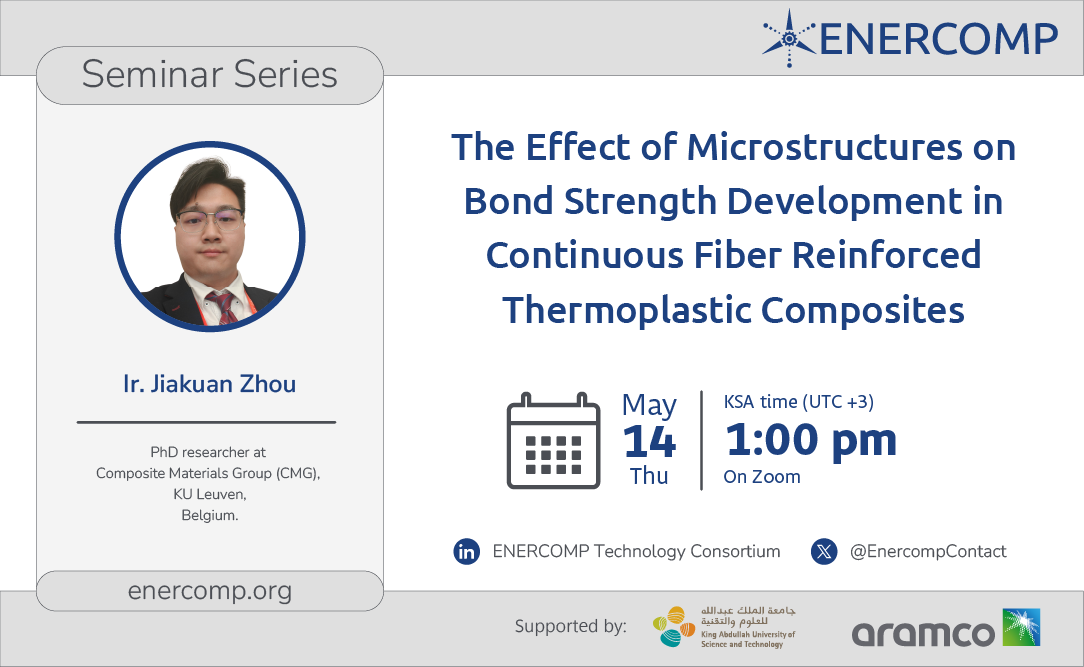
ABSTRACT
This research investigates the relationship between processing conditions, microstructural evolution, and interlaminar bond strength in continuous fiber reinforced thermoplastic composites (CFRTPCs), with a particular focus on unidirectional glass fiber reinforced polypropylene (GF/PP) manufactured via continuous welding. Emphasis is placed on understanding how processing-induced microstructures govern consolidation quality under rapid, non-isothermal conditions relevant to industrial techniques such as automated tape placement and in-situ welding. An integrated experimental and analytical framework is developed, combining material characterization, process design, and multi-scale microstructural analysis. Key material features—including fiber distribution, void content, rheological behavior, and crystallization characteristics—are first quantified and linked to processability. A dedicated high-speed continuous welding setup is then established to enable controlled fabrication of thin laminates, serving as a representative platform for studying bond formation. Interlaminar bonding is analyzed within the framework of thermoplastic fusion bonding, involving intimate contact and autohesion. A predictive model for intimate contact is validated experimentally, and a novel optical method is proposed to quantify contact quality over large areas. Mechanical performance is evaluated using wedge peel tests, supported by in-situ observations of crack propagation. Results show that fast cooling nearly doubles bond strength compared to slow cooling. While thermal analysis reveals reduced crystallinity and increased ductility at higher cooling rates, these factors alone do not explain the observed improvements. Microstructural analysis demonstrates that cooling rate strongly affects fiber–matrix interfacial morphology: fast cooling promotes finer, more amorphous-rich interfacial structures that enhance adhesion, whereas slow cooling leads to transcrystalline morphologies associated with weaker interfaces. A microstructure-informed failure hypothesis is proposed, in which crack propagation is governed by competition between the fiber–matrix interface and adjacent grain boundaries. This is supported by nanoindentation, tensile testing, and single-fiber pull-out experiments. Overall, the work highlights the dominant role of interfacial morphology in bond strength development and provides guidance for optimizing high-speed composite manufacturing processes.
About the speaker
Jiakuan Zhou, currently a PhD researcher at Composite Materials Group (CMG), Department of Materials Engineering, KU Leuven, Belgium. My research focuses on process and application development of composites within the frame of SIM ICON ProUD project, with Prof. Jan Ivens. Specifically, the research experience as well as industrial consultant experience are related to continuous welding and pultrusion of (hybrid) fiber reinforced thermoplastic composites, microstructures evolution and the links to mechanical performance, and process modeling.