
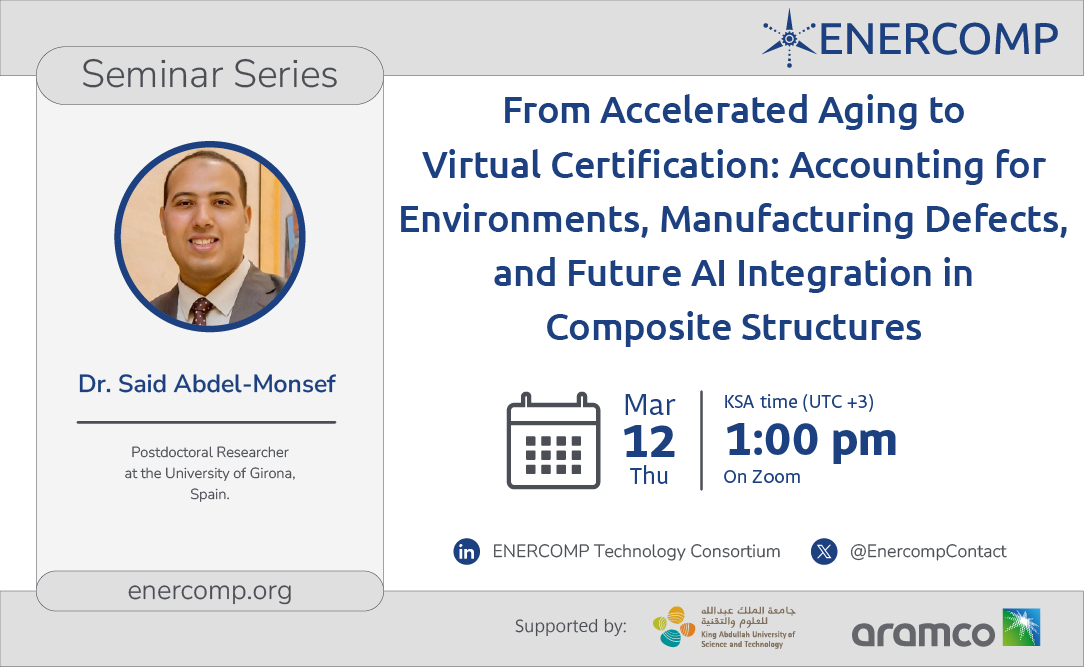
From Accelerated Aging to Virtual Certification: Accounting for Environments, Manufacturing Defects, and Future AI Integration in Composite Structures
Thursday, March 12th, 2026
ABSTRACT
The widespread adoption of composite materials in aerospace and civil engineering is often limited by their complex, long-term degradation. Unlike traditional materials, composites are highly susceptible to the combined effects of harsh environmental aging, such as temperature extremes and moisture absorption, and inevitable manufacturing defects. To ensure structural safety, the industry currently relies on the expensive and time-consuming physical "building block approach," applying highly conservative "knock-down factors" to account for these unknown variables.
This seminar presents a comprehensive methodology to move the industry from exhaustive physical testing toward cost-effective Virtual Certification. We will first explore the fundamental mechanics of environmental degradation, highlighting the dangerous synergy between hygrothermal aging and manufacturing flaws (such as gaps and voids) which actively accelerate structural deterioration. By extracting the exact degraded material properties and applying Uncertainty Quantification (UQ), we will demonstrate how high-fidelity Finite Element Models (FEM) can propagate these variables to virtually calculate reliable safety margins. Finally, the presentation will outline ongoing research into the integration of Artificial Intelligence (AI), showcasing how machine learning surrogate models will soon bypass computationally heavy simulations to enable the rapid, near-instantaneous optimization of next-generation composite structures.
About the speaker
Dr. Said Abdel-Monsef is a structural engineer and postdoctoral researcher specializing in composite mechanics, bonded joints, and uncertainty quantification for civil and aeronautical structures. He holds a PhD in Mechanics of Materials and Structures from the Universitat de Girona, which he earned with an "excellent (cum Laude)" ranking in 2020. Currently, he serves as a Postdoctoral Researcher at the University of Girona, where his work heavily focuses on building digital-twin-oriented workflows and developing secure simulation ecosystems for virtual prototyping in the aeronautics sector.