

Thursday, 2 April, 2026
SASCOM Seminar Series - Enhancing adhesive bonding performance by manipulating intrinsic and extrinsic dissipations.
On April 6th, Prof. Gilles Lubineau, professor of Mechanical Engineering in the Physical Science and Engineering Division at KAUST, P.I. Of the Laboratory of Mechanics for Energy and Mobility (MCEM), and Director of ENERCOMP, will deliver a talk as part of the SASCOM Seminar Series titled “Enhancing adhesive bonding performance by manipulating intrinsic and extrinsic dissipations.”
Reducing emissions of pollutants is a key priority to fight again the climatic changes that we are going to face over the 21st century. More and more pressing environmental constraints are shaping the new technological solutions in the transportation sector, from personal cars up to mass air transport. Automotive and aerospace industries are then seeking new solutions to create lighter structures to reduce fuel consumption or make easier the transition to electrical vehicles.
Extreme lightweight structures can today be obtained by using high-performance composites based on continuous fibers and polymeric matrices. These materials that were reserved before to high tech industries, will become even more common tomorrow with the expected cut in the production cost of carbon fibers. Assembling composite parts is however still a challenge that often jeopardizes the energy efficiency of structures. Classical joining techniques, such as bolting and riveting, add to the total structural weight and require hole drilling. These result in extra cost due to manufacturing and to extra weight (due to rivets/bolt and locally increased composite thickness to ensure integrity of the substrate). Designers have thought for a long time about replacing the “bolted” solution with integral adhesive bonding. In such joints, the mechanical cohesion between parts is only ensured by an intermediary adhesive layer. This would minimize the additional work and weight needed to realize the assembly.
However, integral adhesive bonding is not used for primary structure today, because of its extreme sensitivity to the quality of the substrate preparation that can largely modify the intrinsic performance of the joint. More important for us, the failure of adhesive joints is often unstable: the joint behaves well until the development of a catastrophic crack that would propagate throughout the whole joint, resulting in the loss of the application. In a sense, adhesive-based-design is missing today the “crack arrest” function that is fulfilled by bolts. There are arresting the cracks even in case of premature failure, providing enough time to repair the structure before catastrophic failure.
Our objective is here to introduce new strategies to equip by design adhesive interfaces with crack arrest features. From a practical point of view, we are manipulating the R-curve of the interface by introducing non-local dissipative mechanisms, such as bridging, that will add to the classical cohesive energy of the adhesive
To attend this insightful talk, please register for the Zoom session on the SASCOM website.
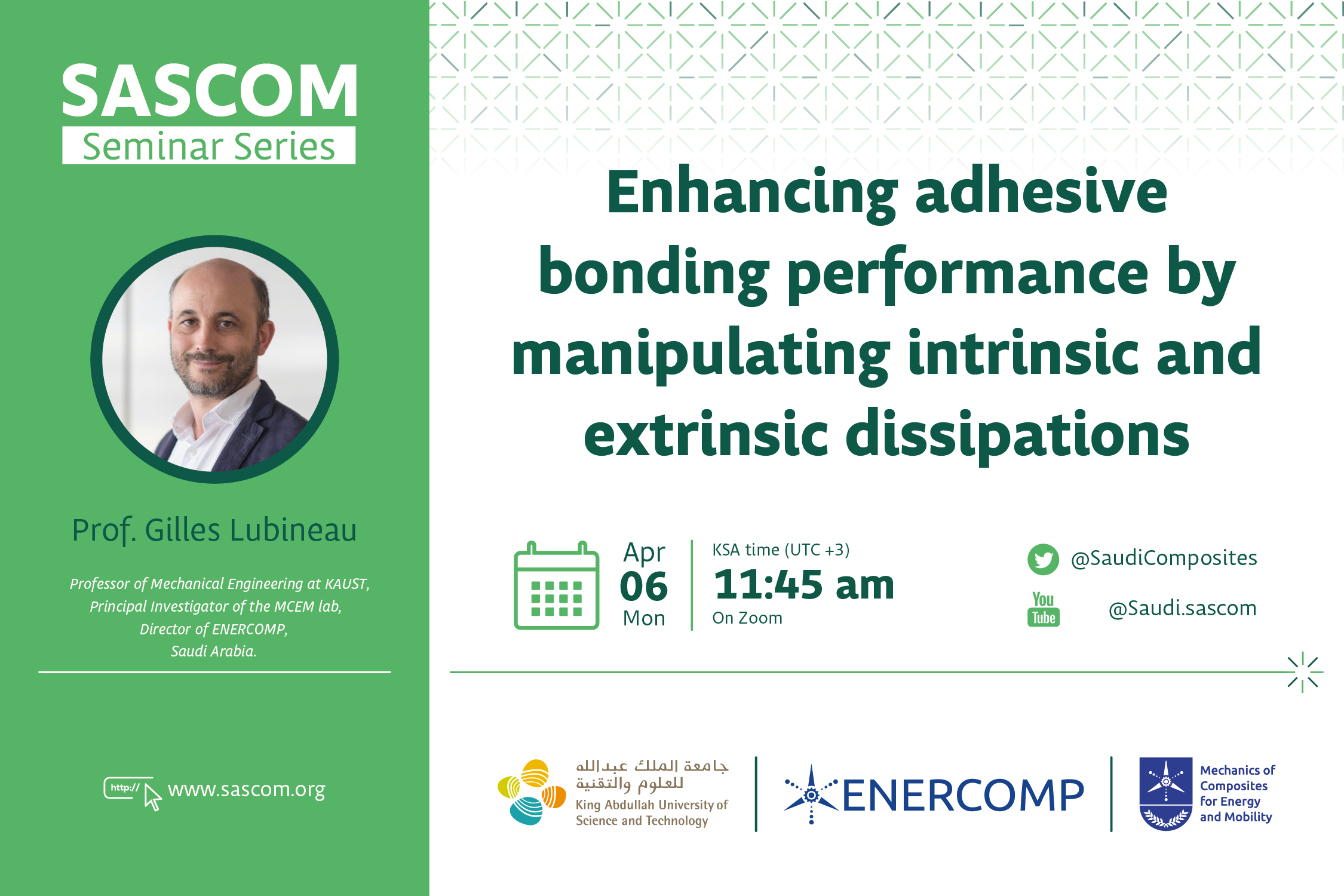
Date: Monday, April 6th, 2026
Time: 11:45 am (UTC+3)
Location: On Zoom